

The 1H-EID Graduate School awards 3-year doctoral contracts to French or international students. The call will be open from March 20th, 2026 to April 17th, 2026 at 1:00 PM CET CET, for a contract commencement on September 1st, 2026. Please note that this call is independent of the doctoral school (ED) competitions.

The thesis supervisor must submit an application for a thesis project and one single candidate. It is the thesis supervisor’s responsibility to ensure strict compliance with the rules of their Doctoral School (in particular regarding the supervision ratio, other application rules based on previously obtained doctoral contracts, etc.).
Please note that a thesis supervisor will not be granted two doctoral contracts, two years in a row.
The thesis supervisor must belong to a research structure affiliated with one of the four partners of the graduate school and be attached to one of the partners EDs:
- ED 562 BioSPC – mainly the « Infectiologie et Microbiologie » department (UPCité)
- ED 393 Pierre Louis de santé publique (SU et UPCité)
- ED 624 Sciences des Sociétés (UPCité)
- ED 563 Médicament, Toxicologie, Chimie, Imageries (UPCité)
- ED 581 ABIES (UPSaclay AgroParisTech, ENVA, URCA)
- ED 515 Complexité du Vivant (SU)
The candidate and the thesis director must provide several documents (see Appendix I: required documents). The documents must be compiled in a single PDF, following the order of the checklist, and sent by e-mail to the address: gradschool.1health-eid@u-paris.fr before April 17th, 2026 at 1:00 PM CET.
The preselected candidates will be interviewed by an interdisciplinary jury on June 10th 2026. Candidates can choose to present either in English or in French.
The evaluation criteria for the research project will focus on:
- the theme and scientific quality of the project which must focus on emerging infectious diseases*
- the consistency between the project and the research topics of the host laboratory
- the correspondence of the candidate’s scientific profile with the research project
- the agreement between the project and the professional perspectives of the candidate
We strongly encourage projects that span across two thematic fields of the Graduate School (biology of emerging pathogens, epidemiology and biostatistics, animal environment and human interfaces, evolutionary genomics and social sciences and humanities) and/or projects that involve collaboration between two partners.
The criteria for evaluating candidates will focus on:
- the solidity of their academic curriculum (biology, health, epidemiology/public health, veterinary sciences, engineering sciences, humanities and social sciences),
- their motivation to join an interdisciplinary course,
- their interest in and previous experiences with emerging infectious diseases and One Health approaches,
- their career project and professional perspectives in this field,
All pre-selected candidates will be attached to the doctoral program of the Graduate School 1H-EID. They will benefit from mobility scholarship opportunities, transdisciplinary doctoral training and will be invited to participate in Summer Schools.
* For the purpose of this call, diseases caused in humans or animals by pathogens with a high risk of triggering a health crisis, are considered (Re)Emerging Infectious Diseases, based on the following criteria:
- Potentially significant clinical impact on human health
- High probability of introduction and spread
- Strong potential for evolution
- Strong societal and economic impact
For reference, check here the list of pathogens considered as priority by the ANRS-MIE.
This list is not exhaustive. A project focusing on an infectious disease, meeting the above characteristics may be considered. In particular, an infectious disease caused by agents vectored by arthropods, or by pathogens (bacteria, viruses, parasites, fungi) with emerging resistance to first-line anti-infective agents and potential for pandemic evolution, will be considered as relevant.
Projects based on a “One Health” approach are particularly encouraged.
À lire aussi

Applications for the second year of the Emerging Infectious Diseases Master’s program are now open!
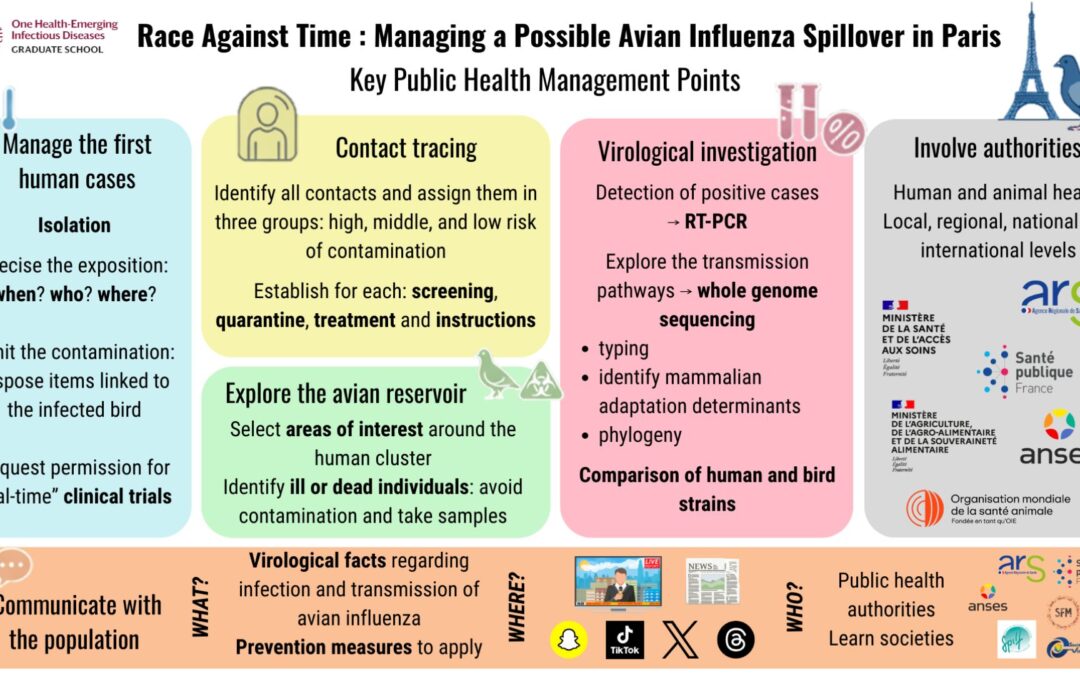
Case study: the hidden journey of a disease outbreak
Imagine you are having lunch with family or out with friends when suddenly a news alert appears on TV or social media: new cases of influenza are spreading across your country. Have you ever wondered what happens before this information reaches you? This is the...

A Look Back at the 1H-EID Graduate School Webinar Series
The Graduate School One Health Emerging Infectious Diseases (1H-EID) has successfully launched two exciting webinar series that bring together researchers, practitioners, and students around critical health issues and pandemic preparedness. One Health Research in...
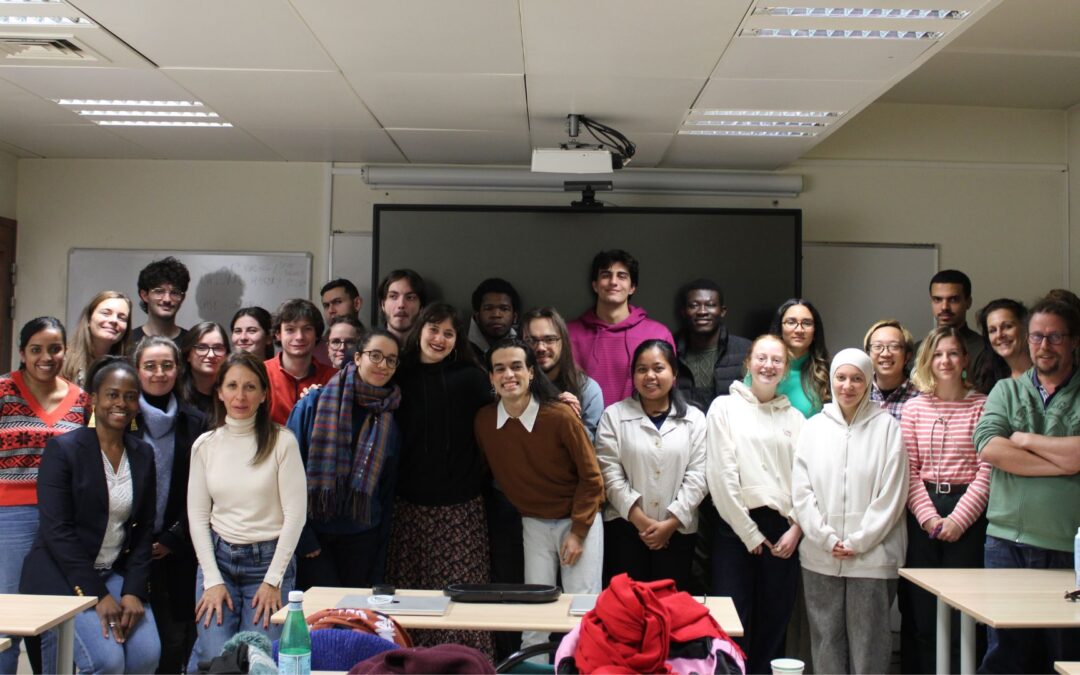
From The Field Week: A Unique Learning Experience
We're thrilled to share highlights from this year's "From the Field" teaching unit, a distinctive and dynamic component of the Graduate School One Health Emerging Infectious Diseases (1H-EID) program, expertly organized by Solen Kernéis, Loïc Epelboin, and Nathan...